
May 11 2026
Activity assessment – ‘An oldie but a goodie’
This is the final part in our series of articles looking at some of the pitfalls associated with fingerprint evidence. Over the last three weeks we’ve focused on the ‘who’ and ‘how’ questions of fingerprint interpretation [Part 1; Part 2; Part 3]; this week we’re going to take a look at fingerprint persistence.
It’s tempting to presume that fingerprints won’t last indefinitely and would probably be lost quite quickly if they’re on commonly touched surfaces or outdoors. But is this correct?
In a commercial burglary case, fingerprint evidence linked a suspect, a former key holder, to the scene by virtue of a print on an internal door frame. The prosecution alleged that the print must have been placed recently as the doorway had been painted after the accused had last had access to the premises. Case closed? Not quite. It turned out that the fingerprint was in paint; and more accurately in a layer of paint beneath the most recent. This clearly showed that the fingerprint had been placed some time prior to the alleged burglary, and potentially, as claimed by the defendant, at a time when he had legitimate access to the scene.
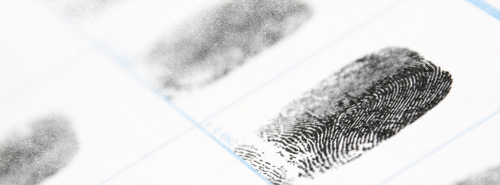
These types of cases might seem like ‘one-in-a-million’, but we’ve seen it several times. The metal security gate case, which was showcased in part 3 of this series, is one example, and another, perhaps even more astounding, is a case where fingerprints were found on a “regularly cleaned” window frame in a school, but turned out to be from someone who manufactured the windows 15 years previously.
Without an intimate understanding of what is and isn’t possible it’s tempting to dismiss things that seem unrealistic but that in reality may be perfectly feasible. When it comes to assessing the significance of fingerprint evidence in the case context there is only one rule; don’t assume, instruct an expert!
This concludes our four-part series looking at some of the issues and pitfalls associated with fingerprint evidence. We hope you have found it interesting and thought provoking, but most importantly we hope you’ll take away that there is more to fingerprints than simple identification, and that no aspects of fingerprint evidence is immune to error.
Keith Borer Consultants is a leading provider of forensic science expert witness consultancy and has been providing services to the Criminal Justice System for more than four decades. If you have a case involving disputed fingerprint evidence, or any of the broad range of specialisms our numerous experts cover (see our website), please do not hesitate to email kbc@keithborer.co.uk or call us on 0191 332 4999.