
June 04 2026
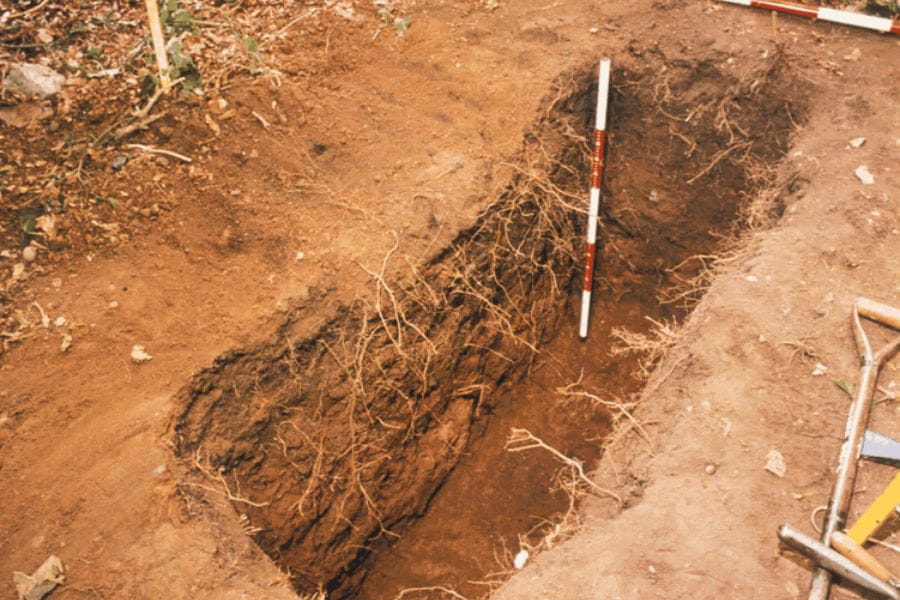
Forensic archaeology is a branch of forensic science specialising in locating, recovering and interpretating buried or concealed materials, such as human remains or evidence linked to criminal activity. Forensic archaeologists play a critical role in the interpretation of evidence from incident scenes and must ultimately be able to present expert witness testimony that can withstand rigorous legal scrutiny. They must therefore be both highly skilled and employ methods that meet the highest scientific standards. This demands both technical precision and extensive real-world experience – qualities exemplified by the expert team at Cellmark Forensic Services.
What Does a Forensic Archaeologist Do?
As Forensic Archaeologists, a lot of our work centres on understanding disturbance/ environmental change, so in effect how the ground, structures, or landscapes have been altered, and what that tells us about human activity at incident scenes.
At the core of the Forensic Archaeologist’s role is the examination of sites where evidence – such as buried human remains, drugs or weapons – is thought to be concealed. By carefully examining the ground and surrounding environment, trained and competent experts can identify subtle signs of disturbance and use this to focus searches and locate human remains and evidence that would otherwise have remained hidden.
Finding, recovering and documenting hidden items, or the body of a deceased person, is, however, only part of what a Forensic Archaeologist does. As with any other form of forensic evidence it’s often not just what’s found that’s important; it’s what it means. To put findings into context Forensic Archaeologists routinely consider:
These interpretations are crucial to avoiding misrepresentations that may otherwise affect the direction of a case and must be supported by documented factual observations.
What Else Do We Do?
In many cases, understanding an incident scene extends beyond the forensic examination of the area of interest. This is where advanced analytical techniques, such as 2D mapping, digital 3D modelling and scene reconstruction, can make a significant difference.
Our ability to create detailed 2D maps and photo-realistic digital 3D models of incident scenes allows us to provide clear and accurate visualisations that can bring otherwise inaccessible crime scenes to life, show key object locations and orientations, and facilitate/illustrate line-of-sight and viewshed assessments (“viewshed” being the geographical area visible from a specific position). Expert analysis of historical records, mapping, photographs and video footage enables us to reconstruct past landscapes, which can be particularly valuable in cases where significant changes have occurred over time and the present-day scene looks very different from how it appeared at the time of an incident. Adding the positions of people, objects and vehicles, using information from witness statements and other intelligence, can further assist event reconstruction.
Additionally, while forensic archaeology is often associated with murder investigations, our expertise is equally valuable in a variety of other contexts, such as civil disputes involving land or environmental change and heritage crime investigations, including damage to archaeological sites or artefact theft, identifying signs of unauthorised excavation or assessing damage to protected sites.
Why Would You Need to Instruct a Forensic Archaeologist?
Aside from the obvious (examination of scenes where human remains have been found or are being searched for), Forensic Archaeologists can add value in many cases that feature complex incident scenes, or where there has been interpretation of item/body concealment findings. As for any other scientific discipline, forensic archaeology often culminates in opinion evidence and is therefore susceptible to:
Forensic archaeology is a highly specialised field and not all ‘experts’ will have the same level of experience, accreditation, competence, or peer review, or necessarily be familiar with the requirements and nuances of the different elements of UK justice systems. Shortcomings in this regard can affected the reliability and admissibility of otherwise seemingly compelling evidence.
To conclude
Forensic archaeology provides a unique and critical bridge between science, environment and investigation. By applying rigorous archaeological methods, it enables the careful recovery, interpretation and contextualisation of evidence that might otherwise remain hidden, misunderstood or misrepresented. From locating concealed items and establishing event timelines to reconstructing complex scenes through advanced mapping and 3D modelling, the discipline plays a vital role in supporting both criminal and civil proceedings.
Importantly, the value of forensic archaeology lies not only in what is discovered, but in how those discoveries are interpreted. Robust methodology, accurate recording and balanced, evidence-led evaluation are essential to ensuring that findings withstand scrutiny and genuinely assist the court. When applied by experienced, competent practitioners, such as the team at Cellmark Forensic Services, forensic archaeology can clarify uncertainty and challenge assumptions. Whether addressing recent incidents or older police investigations, forensic archaeology continues to demonstrate its relevance “from the ground up”- using evidence from scene examinations to provide insight, precision and clarity in even the most complex investigative scenarios.
If you need the services of a Forensic Archaeologist to assist with a site examination or assessment, or have a case that involves forensic archaeology and you want to be sure reported findings and conclusions are robust, contact Alastair Vannan or Alison Brough on 01235 528609 by asking for Specialist Forensic Services, or email/call Keith Borer Consultants (kbc@keithborer.co.uk; 0191 3324999) and they’ll make the introduction. Email the team using specialistforensicservices@cellmark.co.uk.

